Showing posts with label Cameron. Show all posts

November 9, 2012

Limits

In calculus, we define the limit of a function f(x) as the value L that f(x) approaches as x gets close to some fixed point c. We say as x->c, f(x)->L. This value L does not have to be a part of the range of the function; it's a value that you approach as you get closer and closer to c, without actually getting to c. 

I think about limits a lot. Not because I've had to formalize the definition of a limit in my Advanced Calculus class (over, and over, and over...). No, it's not because it's such an important reference from Mean Girls. It's because I think about how close I get to speaking up, approaching a guy, and get the courage to ask him out...

and never actually do it.

It's semiformal season, and I would like to ask somebody to come with me. But the sheer thought of going up to the person I like and mincing words together that make me sound like an intelligible human being gives me chills. I've sat in my room contemplating the worst forms of rejection I could potentially face, and every time, when I realize that I'm just wasting time and energy, I become a little more courageous and approach the limit that I'm interested in evaluating. Yet when it comes to the actual execution, I retreat, and move farther away from the limit.

I like to think I know my limits. I know who is and who isn't within my options, or so I think. Every person that I've liked recently falls within my "not gonna happen" category, due to the lack of faith I have in myself. Instead of attempting to move closer to my point of interest, I try and build an open set around my current location in my development and hope to capture my limit of interest. This open set seems closed from my perspective, and I shut out everybody because I find that I'm still not ready.

I've spent the past year "free-of-thinking-about-relationships" because I needed to take care of myself. Previously, I found my relationship function going on tangent curves and taking on indeterminate values because I did not have time to evaluate my personal limits when I was scrambling to find a boyfriend. My self-esteem was on an asymptote, heading for negative infinity and lacking any hopes for increasing. Once I started taking care of myself, my functions became bounded and smoother, and I have found myself at a stable equilibrium.

But now that I've worked on improving myself, taking time to evaluate my limits, I'm back to confusion at the limit of a potential relationship as I approach this guy. I want to make sure I'm avoiding an unstable point, and getting closer and closer to building up my courage.

I'm not content with approaching the limit and getting closer and closer.

I want to reach this elusive point.

The limit unfortunately does not tell us what the function is at this point. The limit gives the behavior as you get closer and closer, but often, as is life, the function is discontinuous, and the evaluation is not the same as the limit. This is a concern in prediction, because even if the limit seems certain, no matter how "confident" I think I will be rejected, as the limit tells me, there is still the opportunity for a disjunction, and I might be happily surprised.

The curve is status quo; it's reaching beyond the toolbox of limitations that makes this so much fun.

October 10, 2012

Signals

[Editor's Note: Just a quick heads up y'all, tonight is a Blue Devils United general body meeting. We'll be down in the Center for LGBT Life at 7:00 PM]

A signal is a function, which varies in time and/or space, and transmits information or some phenomena. In terms of electrical engineering and signal processing, these signals have various properties that allow us to store important information in terms of discretized data points. Simply, an input signal is entered into a system, which then modifies the signal to give some response, namely the output. We are surrounded by signals: talking, lights (i.e. vision), even hormones are signals.

Another signal we often encounter...are mixed signals. Yes, I just introduced my engineering nerd credibility to talk about flirting and relationships, get over it. But I think it's something important to talk about.

Fun fact: I'm a terrible flirt. I am somebody who doesn't know when I'm flirting with somebody, and likewise, I do not know when I'm being flirted at, and usually it takes one of my introspective showers to realize that I was flirting with some guy...two years ago. At the same point, I think we develop personal filters that block out certain mixed signals or transform signals to our own psychological fit.

As somebody who has struggled with self image, reading Jacob Tobia's fantastic article on HuffPo inspired me to write this post. Mentioned above, a very common signal we are faced with is sight. The photons that are reflected off of our body, clothing, hair, etc. are received by our eyes, and then our brain, the system in this case, modifies the signal into what we perceive, the attractiveness of others. It seems like such a simple process, but with profound outputs. How can light so radically divide the LGBT community? How does the brain process the images that can sink our self-esteem?

Jacob raises some great points about why this case. But since I'm a nerd, I think of it as such: Our brains are a system with a certain response function, call it h(t). This function has been warped by the images that surround us in popular culture so that, when x(t), the input (i.e. visual signals) are modified by h(t), they are convoluted with this external notions of attractiveness (by the way, convolutions are actually a term in signal processing, indicated by x(t)*h(t)). Now again, there is nothing wrong with being fit, in shape, six-pack abs and so on, but why does this have to be the only anticipated output, when not every person fits this mold?

I think it's worth looking at how our response functions filter out certain people based on appearance. Or even based on how stupidly we (read: I) flirt with others (or unknowingly flirt). Sometimes there are mixed signals or visual signals, but intertwined with those signals is superimposed information that's worth knowing.

September 7, 2012

Unnatural

When it comes to nucleotides and amino acids, evolutionary processes have led us to four bases and twenty amino acids that are utilized in our everyday biological chemistry. Even better, this is also universal: with very few exceptions, all organisms across all domains of life use these same nucleotides and amino acids to form DNA and proteins that guide our functions. The chemistry of amino acids and nucleotides aren't too complicated (although if you're in Bio201, biochem, or anything of the sort you might disagree with me); with some minor tweaks and substitutions, it is simple to construct new nucleobases and synthetic amino acids that, while novel, are unnatural, and do not conform to the central dogma of molecular biology.

I arrived to campus two years ago, and I felt like an unnatural amino acid: out of place, weird, and synthetic. I was putting on a face that was going to get me through college. I had to pretend to be "natural." Straying away from the chemistry, I was shy and unsure of what college was about to throw at me. My introversion kept me indoors, avoiding parties, and wondering about what I was missing. I wanted to incorporate myself into the Duke mainstream, but every time I tried for the first month, I felt rejected. Coming from high school where I was well liked, college was a different feeling as I searched for acceptance. No matter how much I attempted to conform to the Duke "culture," even the "culture" within the LGBTQ community, I felt unnatural.

Synthetic amino acids are peculiar because when substituted for a natural amino acid in proteins, they can shut down the protein's function and destroy the native structure. In addition, synthetic nucleotides can incorporate mutations into DNA if included in DNA synthesis and replication. Well, this is exactly how I felt coming in to Duke. Even if I wanted to fit into the community, I wouldn't contribute anything, or I would screw something up, both personally and communally. What did I know about LGBTQ activism? I had only been out for five months. What meaningful relationships could I form? I'm too awkward to interact with people, and how would I even be remembered? Me, the unnatural amino acid, wouldn't survive selective pressures and I would get flushed out as unimportant or extraneous.

Yet here I am, two years later, still writing for this fantastic blog that has been such an important part of my Duke career and my stable integration into the LGBTQ community. Remember how I said unnatural amino acids and nucleotides are, well..."unnatural"? How I said that they can stop a protein from functioning or mutate DNA? Well, these are true statements, in some regards. However, unnatural amino acids have been show to improve immunogenic response to self proteins that are involved in autoimmune disorders and could stop inflammation and toxic shock response. Unnatural nucleotides are used in a specific assay to detect very small amounts of viral DNA to see if HIV or HCV is dormant, on the rise, or eliminated. And the utility of these two synthetic biology tools is only increasing, not only for medical advances, but also to improve basic sciences research and develop a better understanding of ourselves and the origins of life.

I realized that being "unnatural" did not mean that I had no role in this community. In fact, as I cited at the beginning, being novel may mean the same as unnatural, but my novelty provided something new to the university and this blog (I mean, who else has a post centered around synthetic biology?). I had to find my niche, and it wasn't the easiest task, but I did find my way. Particularly, writing for this blog has been my way of reaching out to Duke in ways that I can't do by being an engineer, or by being a researcher, and especially by being an introvert. Being a novel, "unnatural," and unique amino acid or nucleotide may just be the tool this community needs to thrive and survive. There is no Duke or LGBTQ "culture" that is supplemented by a few nutrients. The LGBTQ community does not fit one mold, nor four, nor even twenty molds, and conforming to one of these set structures isn't going to advance us. As we welcome a new class of students to Duke, each person needs to appreciate their differences and embrace how we can come together and build a stable community. We need more unnaturalness to progress, so that the DNA strand can hold new structures, and so the peptide chain folds in new ways and confers new functions.

Hopefully I didn't go too crazy with this extended metaphor, but I'm always available to talk (especially if it's on the synthetic biology) via email. To the new class, welcome to Duke, and to the old, welcome back!

April 7, 2012

Significance

Dear Guy in my Statistics Class, 


Okay, so this is slightly weird to be writing a public letter to you, but here goes: I like you. I think you're very attractive and, from what I've gathered in class, quite intelligent. Yet, I don't even know you. Frankly, I'm not even sure what your name is. But more importantly, I don't even know if you're attracted to men (which, I suppose is the important thing for me). Honestly, I'd just like to get to know you better; you seem like a really nice person, but given our zero previous interactions, I feel that trying to start up a conversation with you this late in the semester would be very awkward. I don't even know if you know who I am, but if you do, say hi to me, so that socially-awkward me doesn't have to and then further embarrass myself. 


My letter presents the following set of hypotheses.

H0: He is not attracted to men.
Ha: He is attracted to men.

In statistics, we can either accept the null hypothesis or reject it in favor of the alternative hypothesis. The objective is, based on statistically significant evidence, we would be able to arrive at the correct conclusion. However, it is very possible to come to a false positive or a false negative conclusion. In the case above, I risk making a type I error, which is the case where I reject the null (and conclude that he is attracted to men) when the reality is that the null is true (he isn't attracted to men). So let's say I were to act on this. The end result is pretty clear: I would just make a fool of myself. I would hope that this would be the last interaction I have with this guy, and then I would try and get over the trauma of what I did. I can also make a type II error, which is the situation where I fail to reject the null (and say that he is not attracted to men) when the reality is that the null is false (so he is attracted to men). So in this case, I would just go about my daily life and nothing would happen on my end, when there potentially could have been something, but I was too afraid and too cautious to start the conversation. I don't know how people discuss sexuality from a "tabula rasa" standpoint of first meeting a guy, but I am curious, if people want to provide insight for me, please leave a comment. My "gaydar" is and has been dysfunctional for about two years, so I can't use that, and even if I did have good gaydar, I don't know how I would then approach a total stranger in this current context. However, given no current methods to test these hypotheses without building up a lot of courage and engineering a conversation, I resort to extrapolation.

I've been faced with this situation many times before, except for the fact that I've known the people that I'm attracted to, and I've known that they are gay (okay, so it's the exact opposite?). And given this, I've never had the courage to ask somebody out. In terms of subtle flirting and "signs", I'm pretty good at that, but it's never a conscious choice and I never then ask the guy out. I often fear asking guys out because of the underlying context of dating and hypersexualization of gay relationships, but that's another post. I also just lack the self-confidence I need to ask somebody out. I don't know where everybody is getting their confidence from, but I would like some leftovers, if possible. So given these associations I have with dating and asking people out (and lack thereof), I correlate this to the situation above, and risk making a type II error, which seems like a better option to me than making a type I error.

Using prior evidence in order to motivate my future directions on relationships is perhaps not the healthiest option, but using a Bayesian framework, this seems to be the most natural approach. However, this is what I've been doing. I don't seem to understand how people can just make friends/relationships with strangers so quickly; perhaps it's just my introversion, but even in a natural setting for me such as the classroom, I've often met my best friends. I don't want to be shy Cameron who never meets other people, but I feel that is the only option for me to maintain my sanity.

And then there is the matter of what makes a result significant. What outcome would I want for the efforts of my experiment or trial to be worth the cost I put into it? If that is a relationship or just meeting a new person and making a new friend, then perhaps the ends justify the means. But how likely will this be the case?

January 7, 2012

The Introvert Who Wanted To Be An Extrovert


Happy New Year everybody! I hope that you have had a wonderful break and whether you like it or not, I hope you’re ready for another semester! I’ve had a pretty boring break, but I’ve been hard at work on an important Quidditch project for the IQA, so it has kept me busy. Also, if there are any Class of 2016ers who are reading the blog, welcome to the Duke family! We’re awaiting your arrival here in a short eight months (or four if you visit for Blue Devil Days).

If you have read my posts in the past, you know that I have often made known that I am an introvert (Actually, I’ve been pretty vocal about it, which has some ironic undertones).  By saying that I am an introvert is in no way to undermine being an extrovert, but rather I want to make it well known that I identify as an introvert and I wouldn’t want to be mistaken otherwise. I’ve had to “come out” as an introvert a few times this past year since some people did not believe me.  Needless to say, it can be very exhausting and disheartening when people don’t believe me, but alas, it’s the truth. It’s a shame that I’m often just assumed to be an extrovert, and on at least one occasion, I was pretty much assumed to be an extrovert because I am gay. This is also a serious case of stereotyping, but I reserve this argument for a later time.

I have made the argument in the past that the LGBTQ community is meant for extroverts. Bars, clubs, pride parades and other socials events provide evidence for my claim, with very little evidence for introvert-guided activities, at least that I’ve noticed in college. As an introvert, I have a difficult time immersing myself into a crowd of extroverts with the intention of meeting somebody. Being an introvert is not a temporary state or mood; it is a trait of personality, and by no means does it imply that I’m enjoying being single. Yet when the majority of the LGBT individuals I meet are highly outgoing and extroverted, I lose hope every day of finding another introvert. I have tried very hard to lean into discomfort and go to some events to meet people that made me feel very uncomfortable, but every time I do so, I feel like I’m being judged. I feel like people are fully aware of my social awkwardness and I beat myself up every time because of my looks and because I’m socially awkward, when in reality it is my introversion that holds me back from talking to new people at such events.  The issues with my appearance deal with the lack of self-confidence I have in such situations because extroverts tend to exude confidence more, which is quite the downer for me.

I know that I’m probably preaching to the choir here, but I write this to make a point. And it’s a very simple point. A point that makes me very angry and upset at the very thought of it.

I wish I were an extrovert.

I have been struggling with this for a long time, since being extroverted is inherently not me. It’s a shame that I’m essentially trying to deny a very important part of my personality, but when I feel that I am repeatedly told by the gay community that introverts are “wrong,” I cannot help but feel this way.  If I were an extrovert, I would be able to talk to guys with some social acuity. I would actually be able to talk to somebody on Facebook as opposed to opening a guy’s chat window (who is typically an extrovert), typing out various greetings, and then erasing them for fear of being perceived as a stalker or a creep.  I would actually get to experience rejection from somebody else as opposed to experiencing self-rejection.  And who knows? Maybe I would have a little better self-esteem and self-confidence.

Recently on the blog, there have been many posts on identity, insecurity, and questioning. I write my post to provide a different perspective on my own form of identity and insecurities attached to personality within the LGBTQ community. I am very proud of being an introvert, and in my daily activities, my introversion has been a blessing. But in the social realm, I’ve found it to be a curse. I am frequently misunderstood, and while I often place the social barriers on myself, I have to put on my “extroverted” mask in order to go out in public, especially to events with lots of gay guys so that I don’t come off as weird. Yet this act causes me to lose a large portion of my identity. It’s as if I’m living two lives to please everybody, except myself.

If anybody has any other perspective or advice to offer, I greatly appreciate it, not only for me, but others who can empathize with this post. Please know that you are not alone, and even though it may seem daunting, being yourself is truly the only way to be happy. 

November 26, 2011

The Magic of Acceptance

As I sit home for Thanksgiving break, stuffing my face with all of the leftovers, I have had a lot of time to reflect on what I should be thankful for this year. If you remember my last post on the Sophomore Slump, I can definitely assert that it exists; I've been feeling it for the past few months. However, this post is not about that. This post is about what I have been doing to get over the Sophomore Slump. This blog is called Our Lives, and yet, I have not had the chance to talk about an extremely important activity in my life: Quidditch. Yes, I am referring to the wizard sport with quaffles, bludgers, snitches, and brooms from the Harry Potter series. Yes, it exists, and yes, it is amazing! Perhaps the most accepting community I have found in my time at Duke has been the quidditch community all around the world, but especially my team. I will get to my team eventually, but first I want to talk about how quidditch promotes acceptance and equality.

The International Quidditch Association (yes, it exists) has a very strong mission for inclusiveness and equality that I find admirable for an organized sport. While I can spend an entire post explaining the rules of quidditch (you can always ask me if you are curious), I want to emphasize our gender rule, which states:
"Each team must have at least two players [there are seven total players] that are of a different gender than the other players. The gender that a player identifies with is considered to be that player’s gender." -IQA Rulebook 5.0
Quidditch is the only organized sport which is required to be co-ed (to my knowledge), and as of 2012, this rule will be modified so that each team will be required to have at least three players that are of a different gender. This rule has manifested into a core mission of community building in the IQA called Title 9 3/4, which is a combination of Title IX and the train platform, Platform 9 3/4, where the Hogwarts Express is located (and with the new 3:4 ratio, Title 9 3/4 is too perfectly named). I sit on the Rules Council for the IQA, and I have just been so pleased with the IQA's stance on gender equality. Having men and women play in the same sport, in my opinion, helps to aid in the mutual respect of each other for their athletic abilities. Many of the toughest players I've seen have been women, and I know my views have been modified while watching quidditch grow and seeing how strong the players are, regardless of gender. In addition, I was very pleased when we added the second clause of the gender rule. To have this rule and have it be explicit written demonstrates the IQA's commitment to equality within the transgender community, and again, I believe this is unparalleled in any other organized sport.

In my time participating in quidditch for the past year and a half and now recently working with the IQA on referee development, I have had the chance to meet a lot of people from around the world that play quidditch. I cannot find one stereotype for these quidditch players: some are Harry Potter fanatics and others haven't read all seven books. Some played football in high school; others haven't played a sport before. Some are 6'5'', others are 5'0''. I have noticed that there are a fair amount of LGBT players in quidditch, which I have found to be uplifting. In general, many would agree that sports aren't always the most LGBT-friendly, but in my experiences, it is so different in the IQA. In fact, for Valentine's Day this past year, the IQA asked teams to submit quidditch couples, regardless of sexual orientation, and out of the 10 selected couples, I believe 3 of them were same-sex couples, which I thought was amazing! Perhaps J.K. Rowling taught us a lesson in equality and acceptance in the books that has permeated the sport. For me, I've always felt like the oddball growing up. I was never athletic and other than soccer, I wasn't really interested in sports, which made me different from most of my guy friends. Reading Harry Potter put me into a world where I wasn't that oddball and I was accepted for me, not the sport I played for muscles I (don't) have. I dreamed of playing quidditch while growing up, having the wind rush through my hair as I would fly through the air protecting my team from bludgers, and I only wished that would be reality. Due to the creativity of some people at Middlebury who also shared my dream, we now have quidditch. Many quidditch players feel the same way I did growing up, and when I'm surrounded by the sport, I don't feel alone in my sentiment, I only feel acceptance.

But mind you, I have only been involved with the IQA this year. Most of the time I have spent with quidditch has been with my team here at Duke, where I have felt the most acceptance. When I came to Duke last year, I struggled to find my place. I found it very difficult to get involved with the LGBT community at the beginning of last year, which was definitely disheartening at first. However, I found quidditch, and a group of friends that is by far my closest friends at Duke. Maybe it takes running around campus with brooms between our legs being mocked on campus to bring us close together, but whatever it is, it has worked. When I am with my team, I can truly be myself, something that I cannot say for many other groups of people here at Duke. Granted, being myself usually involves yelling at everybody since I'm the referee, but nonetheless, my team knows the real Cameron, and that Cameron is independent of any label.

Quidditch has been magical for me. My team, my best friends, made me want to stay at Duke. So this year, I'm thankful for the team. I've never had such a public forum to thank them, so thank you all. Our trip to New York for the Quidditch World Cup two weeks ago was by far one of the best weekends ever, and all of you made it wonderful. Thank you for dealing with my time constraints and my yelling practice after practice, and thank you for accepting me as one of the team even though I am the lone referee.

We talk about community so much on this blog, and we can spend so much time talking about the LGBT community, but we cannot neglect the other communities we associate with at Duke and in the world. My community may be different from your community, and that's okay, but let us not forget the support we have around us.

Duke Quidditch will be hosting the 2nd Annual Intercollegiate Yule Ball of the Carolinas next Saturday. Come and join us to be a part of the magic that I've been a part of for past year and a half.

October 11, 2011

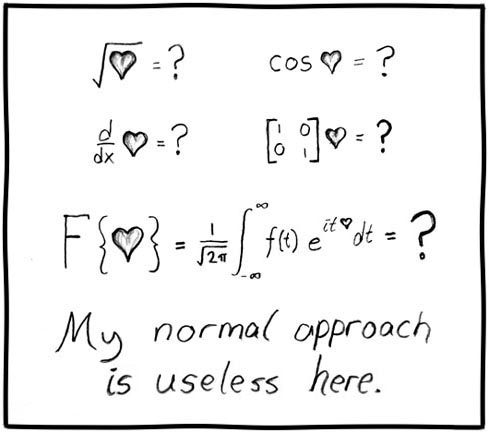
My Normal Approach


"Have the courage to date. If you want to get to know someone, ask him or her to a cup of coffee or a movie."

Those words were Dean Sue's advice to the class of 2014 at last week's Sophomore Commencement as a way to avoid and overcome the sophomore "slump." Sadly, I find myself in a relationship slump as opposed to a sophomore slump, where I find her advice more applicable for me.

I'm a very calculated person. I don't like to make mistakes. I'm a math and science person, so I appreciate universal and proven truths, but I also understand the beauty of experimentation and error to reach a result governed by natural law. If my data is valid, I've only come to one conclusion in my dating and relationship life: I can't use science and math to predict my relationships. There is no formula that I can use. Instead, I'm stuck with taking risks and making mistakes, with the potential to learn from them. One thing comes to mind:
I may or may not have a shirt with this on it...
It's a fact when I say that the LGBT population here at Duke is 1) much smaller than the heterosexual community at Duke and 2) smaller than the LGBT communities at other universities in the world. Does that make it a bad thing? Absolutely not. Does it effectively make the dating pool smaller if only on-campus students are considered? (You must remember, I am an introvert, off-campus is not an option right now) Yes, it does. I would perform a small statistics problem here to prove my point, but this post is already far too nerdy.

I've been in a rough spot for the past four weeks of being back at Duke. Analyzing my life, I've realized that I frankly don't know anything about relationships. I'm fortunate enough to have my career paths well-defined, which I find distorts my feelings on how relationships work. I calculate forming relationships too much, just like I have worked to form my future goals for my life, and I easily get discouraged when one doesn't work out (I call these failures, as my life is governed by a Bernoulli trial (sarcasm, but not really)). That feeling of "failure" then and manifests into internalized struggle and fear that is perpetual. I blame myself. I get angry with myself. It's unhealthy.

I hope to serve as a non-example for you. The failures that I cite above are certainly not failures, they are experiences. Did I make mistakes while trying to start some of the relationships above? You're damn right I did. Do I regret them? Would I do it all over again if I had the chance? Absolutely. Sadly, I do not have that luxury since my Time Turner is in the shop right now. But to quote Oscar Wilde, "Experience is simply the name we give our mistakes." I hope you embrace this quote, as I am working to make it my mantra. (It's not going too well now)

It hurts to hurt. It hurts to be wrong. But if I never got back up after I fell down in any situation, I'd be permanently implanted in the ground. We have to be strong and embrace our pain as a way to grow. Things don't always work out the way we want them to, and that's okay. Sometimes, we have to let the world work the way it wants to before she's kind to us. It's certainly not the end. We will not be Forever Alone. No matter what relationships work or don't work, there will always be one person who is always there for you, and that's you. I love myself. And no matter what happens, I am proud of who I am, and no one can take that away from me. If you haven't had the chance, take some time to form a better relationship with yourself. To quote Mr. Wilde once more, "To love oneself is the beginning of a life-long romance." Get in touch with yourself, so that you can offer your partner or future partner all you have to offer.

Once you know yourself, then maybe you can take Dean Sue's advice. I'm all about clichés and I love caffeine, so I think that her recommendation is important. Take the risk. Because if it works, great! If not, it's never the end.

Now only if I could take this advice and use it myself...

August 21, 2011

"Everything is possible again"


Does the quote that I have selected for the title sound familiar? Well, if you are an incoming member of the class of 2015, then you should have seen that on page 10 of your summer reading book Eating Animals by Jonathan Safran Foer. This post, is for you, 2015ers. One year ago, I was packing up my mom's car, anxious and eager, yet extremely terrified, for what Duke would throw at me. I've been in your same spot. And no matter whether you are out to your family and friends, still closeted, still figuring it out, shy, extroverted, overwhelmed, naïve, or whatever, you are all starting out with a fresh and clean slate. The drama of high school is behind you, now it's time for college.

Being pretty much closeted coming into Duke, I had absolutely no idea what to expect, or what I needed to do to get involved in LGBT activities. But then again, I didn't even know if I wanted to get involved in LGBT life at Duke. I mean, I wasn't even sure if I'd fit in. I figured everybody else would have been out in high school and that I would miss out on opportunities and experiences that I would still be waiting for in the next few years. For the first month of being here, I dealt with so much internal struggle of attending meetings, visiting the LGBT Center, and even coming out to friends, that I felt like I missed out on opportunities. I didn't know who to talk to, or if I wanted to talk about my problems and concerns with anybody, lest I sound like a complainer. I wasn't sure which face I would have to put on in order to go to events, because I was so concerned with how everyone was looking at me. All of these false preconceived notions kept piling on and on, but at one point, I realized I was living a lie. I was lying to myself and I was undermining the very essence of me that I've come to embrace after 18 years of living. I started going to meetings, going to Fab Fridays, and it all culminated in helping pass out Love=Love shirts at Coming Out Day. Once I took that leap, I didn't look back.

Now here I am. One year ago, I feared the result; now, I embrace it.

No matter what background you come from, what race or nationality, what experiences (or lack thereof, in my case) you have, you have to love who you are. And that may be the most difficult task. For the first month and a half that I struggled with coming out at Duke, I hated myself. I hated what I was hiding, and I hated my irrational fears of what others were thinking about me. I wasn't myself. I panicked. Had I completely screwed up already?

I sought help. I talked to my friends, even with fear that they would think of me as the whiniest freshmen on campus. I talked to Janie, I talked to friends back home, I went to events with friends who I trusted, and slowly I reverted back to myself, the real Cameron.

To the Class of 2015: I know that LGBT activism, Fab Fridays, coming out, and many other activities will not appeal to all of you. There is no requirement to be at the LGBT Center every day if you want to "fit in." There is no clique or stereotype that defines the LGBT community at Duke. We all have varying degrees of outness that will influence how involved we are in LGBT life. But honestly, none of that matters to me. I want for you to know the facts, but that's not why I am writing this post. And so to not lose my credibility, I emphasize that this post is not meant to be a cliché blog. This is meant to help.

Be yourself.

I was fake at the beginning. I had my clean slate, and I took advantage of that by trying to be the person I thought everyone wanted me to be. But because of this, I only alienated people and friends. Be the person who applied and was accepted to Duke. The admissions staff works very hard to pick bright and motivated students who can bring something to the Duke community. They selected you because there is something special about you that they saw in your application. Don't let them down. And don't let yourself down. Like I said, I truly hated myself. It was extremely unhealthy, and I regret it all. Take me for an example of what not to do. You may think that you are not special or that there is nothing good about you, but you are sadly mistaken. You have so many wonderful things to offer to Duke, so why would you ruin that? People here want for you to be yourself. I want you to be yourself, simple as that. And when you're feeling lost, seek help. Janie was my life saver, and I know that she will be so glad to talk with any of you.

I chose that specific quote for the title for what it means to me. When Foer's son is born, upon first sight of the newborn, his friend says to him, "Everything is possible again." I find that this can be easily compared to coming to college. The transgressions of the past can fade, and now four years of your undergraduate career is ahead of you. My high school career was great, but I was ready for the college transition so that I could finally be the person and scholar I was destined to be. Everything is possible again at Duke, but it takes the true you to follow whichever path you wish. They are all open to you.

June 26, 2011

Mutant and Proud: Genetics, Environment, and The Fruits of My Research, Part 2

This will be the second part of a two-part post, discussing my amateur genetics enthusiasm as it relates to the "nature versus nurture" argument on homosexuality. This post will look at the propositions of biology and genetics on homosexuality, as well as how my research on the matter went.

In my first post, I discussed the X-Men: First Class movie and it's allegory to LGBT themes (and I'd like to apologize for my error in reporting that Wolverine's adamantium claws were from his mutation). Now in this post, I will discuss some of the research that has been performed to find a genetic, or at least a biological explanation for homosexuality. I will talk also about what I found when I researched this topic.

Many correlative studies have found various biological features to correspond with an increased rate in homosexuality, one being the "birth order hypothesis" in males. This hypothesis states that younger brothers have a 1/3 increased probability of being gay with each older brother in the family. Researchers attribute this possibility not to genetics, but rather the uterine environment and the hormones and antibodies produced during gestation. It is possible that later children of the same mother may receive more or less of a secretion that influences homosexuality. Researchers also point for the uterine environment has one of the main determinants of sexual orientation, since the brain is in development at this time. The hormones, most notably testosterone, secreted for development may "hard-wire" our nerves and brains for an orientation. This may be manifested in a study by Simon LeVay which looks at nuclei of cells from the anterior hypothalamus. LeVay saw that the nuclei of homosexual males were smaller than that of heterosexual males, and similar to those of heterosexual females. Other parts of the brain have been pointed to for correlation as well as the lengths of various body parts and whatnot, but it is very important to note this simple lesson from statistics: correlation does not imply causation. A causal link has yet to be established, which brings up the point of genetics.

Genetics are said to possess the code for our behavior, our adaptations, and our personality. So people started to find specific mutations in the genome that differ between homosexuals and heterosexuals. These variations are called single-nucleotide polymorphisms (SNP, for short), and research led to an SNP on the X chromosome, called Xq28, that may show linkage for homosexuality, and they dubbed this, "the gay gene." Other studies have found this site to not be statistically significant, and point to a few other SNPs on the autosomes as opposed to the sex chromosomes. However, in my opinion, I don't think we can point to one gene and say, "this causes homosexuality." There is a ignorant misunderstanding among Americans as how genes work. While some genetic diseases and traits can be attributed to one gene, and perhaps even one improper nucleotide, most other diseases are caused by an interplay of multiple genes. I believe that homosexuality could potentially be the result of polygenic inheritance, and not just two or three genes, but hundreds of genes. In order for the many biological correlations that are found to be causal, I think that multiple factors have to work together which might, and I'm not a fan of using this word in this context, "cause" homosexuality. In addition, people fail to realize that there are multifactorial phenotypes, not just two or three, and an interplay on these multiple phenotypes may correspond to homosexuality.

So yes, there are some biological and potential genetic markers, but still nothing conclusive. So what about nurturing? An argument against nature is that not all identical twins, who share the same genetic code, do not share the same orientation, and thus, the nurturing of the children is responsible for their orientation and homosexuality cannot be genetic. In response, I point out what is known as the fallacy of genetic determinism, which states that our genes are not the sole indicator of our physiology and behavior. Even the fingerprints of identical twins are not identical. Just because identical twins have the same genes doesn't mean that everything is the same. There's a reason why you can usually discern one twin from another, albeit as tough as it may be. Another argument is that many homosexual males report closer relationships with their mother than their father, which may be a determinant for homosexuality, as the early relationship forms the child's behavior. A study even shows that people who live in urbanized areas as teenagers correlates to higher rates of homosexuality. Many of these observations can possibly correlate and may be causal, and for that, we look at the case for environmental genetics.

Our genes don't just "turn on" because they feel like it. Environmental cues often trigger the activation or repression of genes, I mean, look at puberty. Perhaps there are genes for homosexuality latent in people, but without the proper environmental triggers, be it hormones, pheromones, or neurotransmitters, these genes don't activate. So what, am I saying that the cause of homosexuality is nurture? No, I'm not. But without our environmental conditions, I do not think our natural conditions can be actualized. I attribute this to the different times when people find out they are gay, bi, or trans. If it were truly genetic, maybe we would all discover that we were gay when we were 14 or so. But many people can say they knew before then, and many people don't discover or come out with their homosexuality until they are in their twenties, or even later. Sure, societal pressures may interfere with this, but homosexuality cannot be as cut-and-dry as just our genes, because our genes are not as cut-and-dry as we think they are. From this, I do not subscribe to a "nature versus nurture" argument, but rather a "nature via nurture" belief. Our genetic code cannot operate and make us the unique people we are without the environmental interplay.

So while nature via nurture, in my opinion, is a more valid hypothesis, my research led me to websites where the main court of discussion was either nature or nurture, and not a lot of in-between. Thanks to Google searches and a careful selection of words, I kept pulling up websites by religious organizations, trying to argue the "nature versus nurture" argument using these studies of biology and genetics, and then quoting scripture and the opinions of theologians. Now I'm not one to talk down religion, but many of these sites that weren't from tolerant religious groups were quoting scriptures as a means for understanding the sin and for gays to seek God for a "cure" from their condition. These websites always discussed the biological and genetic studies with a clear bias by stating the evident statistical insignificance of these findings, and how they cannot be true, and that homosexuality is purely a choice. Truly, I was angered that my research kept pulling up these websites, not because of what they said with scripture, but rather because they presented their bias with such force that it made it difficult for me to continue researching. These websites are purely polemic in nature, and for a gay youth who perhaps is not so sure how to balance homosexuality and religion would become alienated by these sites.

So I guess I really haven't answered the question: Are we born this way? Well, I cannot answer that question. But here's a question I can answer: Why should we care? Why should we have to use biology and genetics to certify our orientation? Many people say that a genetic cause for sexual orientation would give us an edge in the battle for equality, but really, will a genetic cause of homosexuality really change the minds of religious extremists and social conservatives?

I guess a better question is, aren't we still human? Don't we still deserve the unalienable rights under the assumption that all men and women are created equal? Why does sexual orientation even matter? Thankfully, New York is the most recent state to answer these questions correctly.

So maybe being gay is caused by a genetic mutation, I don't know. But if it is, I have one thing to say:

I am a mutant, and I am proud of who I am.

June 18, 2011

Mutant and Proud: The X-Men Allegory and Genetics, Part I

This will be the first part of a two-part post, discussing my amateur genetics enthusiasm as it relates to the "nature versus nurture" argument on homosexuality. This post will first describe the LGBT themes in X-Men: First Class and the societal implications, and the next post will look more at the propositions of biology and genetics on homosexuality.

Spoiler alert: For those who have not seen the movie, I may give some things away. You've
been warned.

Yesterday, I watched the movie X-Men: First Class, which outlined the beginning of the X-Men, particularly the rise of Charles Xavier, also known as Professor X, and Erik Lehnsherr, or Magneto, and the disparities in their philosophies on mutants with the human race. As I watched the movie, there were many things that alluded to homosexuality that I never knew. Perhaps the most obvious scene is when a CIA official escorts Professor X to the CIA compound where a young Hank McCoy, a.k.a. Beast, is one of the scientists working on mutant technologies. As the two mutants are introduced, Professor X remarks on how wonderful it is to find another mutant, yet the official is unaware of this fact. When he asks McCoy why he never informed him that he was a mutant, McCoy replies, "You didn't ask, so I didn't tell." This is one of the more "in your face" references, but there are more subtle instances, so I encourage you to watch the movie and find them.

The general premise for the X-Men is the notion that genetic mutations in an individual genome causes the powers the mutants possess, whether that is telepathy and telekinesis, adamantium claws, or storm-conjuring abilities. Some of the genetic mutations cause a phenotypic variation, as seen with Beast, Mystique, or Nightcrawler, to name a few, while others may not cause such a physical abnormality. The majority of mutants discover their abilities either as a child or a teenager, often without control or in anger.

While mutants like Beast and Mystique try to cover up their visible mutations from the rest of society, other mutants with non-visible powers still hide their abilities, for fear of the power they possess and for fear of society's view on their powers. For one example, Beast did not originally take the blue form most of us know, but rather a more human form with over-sized simian hands and feet. However, with his superior intellect and understanding of biochemistry and genetics, he tries to create an antidote for himself and Mystique so they can revert to more human qualities while retaining their mutant powers.

Mystique rejects the antidote, even though she expressed the most interest in being "cured," as Magneto helps her to realize that her true form is beautiful and there is nothing to be ashamed of as a mutant. Beast, on the other hand, takes the antidote, and unfortunately, the antidote enhances the mutation as opposed to repressing it, thus giving us the more familiar Beast. One might draw the comparison between these mutations and what people have called "the gay gene," and how Beast tried to create a cure for his "mutation," yet failed. His attempts to hide his mutant form, analogous to being "in the closet," failed, and he had to "come out" with his improved powers.

The mutants, spearheaded by Professor X and Magneto, decide to help the CIA against the communists of Russia around the beginnings of the Cold War and the Cuban Missile Crisis. Professor X wants to gain the acceptance of human civilization, while Magneto wants to pursue the Hellfire Club, notably Sebastian Shaw, a Nazi scientist who tortured Magneto as a child in a concentration camp so he would use his mutant abilities. During their collaboration, the feelings and philosophies between Xavier and Lehnsherr start to diverge.

One may consider Professor X's philosophy to be based on nurturing while Magneto's is focused on the natural order. While the consensus between the two is that genetic mutations lead to the powers, Professor X wants to train young mutants on how to properly use their powers and to hone in on their abilities, while Magneto wants to gather mutants so they can be the ultimate beings on Earth. In my opinion, this reflects the two sides of the "nature versus nurture" argument, perhaps with more dramatization to reflect the super powered beings. The differences between the views of Professor X and Magneto are not those of "nature versus nurture" of the creation of the mutants, but rather a parallel to "nature versus nurture" argument for homosexuality. In addition, Professor X is also optimistic about
humans accepting mutants if they help prevent a war with Russia, but Magneto is angry with humans, and thinks that, no matter what, humans will turn against mutants so to avoid extinction. (I have heard hypotheses on a possible relationship between the two, and the movie does show a scene with both of them lying together in the same bed at a strip club as they are finding Angel, so this is very possible. There is another scene when the first two first meet and Magneto says "I thought I was the only one." I don't want to give away too much more, so you'll have to watch the movie.)

Skipping a few scenes, we're at the end where Magneto has achieved his mission, and he establishes his new order to foster the superiority of mutants. Magneto wants to be very out and open about being mutants, while Professor X believes that this is inappropriate and will only further provoke the human race. He decides to create his School for Gifted Youngsters to brings mutants who are bullied at home because of their mutations and provides a safe haven for them, thus leading to the creation of the X-Men. This poses many analogies to the LGBT community, including acceptance into the community, degree of openness, and bullying.

The allegory of genetic mutations and the differences they cause in the X-Men can be seen as comparative to what may be the genetic disposition for homosexuality. The debate on the causes of homosexuality always boils down to a "nature versus nurture" argument. Are we born this way? Is being gay due to our nature, our genetic code, a gene or something of the sort, or does parenting and our childhood cause homosexuality? When it comes to the X-Men, genetics dominate, with Juggernaut being an exception. There are plenty of biological markers that lead to a genetic predisposition, so why have we not isolated a gay gene? Why don't all identical twins have the same sexual orientation? Why is it that many gay guys say they spent more time with mom growing up than dad? Or is it more than "nature versus nurture"? I will explore more of these questions and other genetics and biology in my next post, so please be on the lookout for that.

I leave you with a line from the movie. As Mystique decides to go with Magneto at the end, she tells Beast to remember one thing. Our friend Beast, who once rejected his exterior form and even devised a cure so he could be normal. Mystique utters these words to him:

"Mutant, and Proud."

April 24, 2011

One Year Later...

On April 27, 2010, I signed my name on the postcard to accept my admissions offer to Duke.

Now here I am, almost a year later, wrapping up my first year at the school of my dreams. I look back at that day, and I realize that a lot has happened since then. I take this post to reflect.

On May 9th, I took in a friend for the night who was kicked out of his house, with the predominant reason being that he is gay. I had always heard about these situations, but I never understood the severity until that moment. Having to ask my parents that night to let me bring him home, when I wasn't out to them, was odd, but they knew where my heart was. That night is still in my head, and I always think of my friend and the struggle he faces. I know I'm very fortunate with my family situation, and I can only hope that one day, he will be able to enjoy life being who he is, and not who his parents want him to be.

On May 15th, I started my first relationship. Needless to say, the three months that we had together were wonderful. Before we left for college, I wrote him a sappy love letter, being the big sap that I am, and I kept a copy for myself, just for memories. I pulled out the letter last week, and I realized that I am just a huge sucker, and I was just so happy to be with him. (I may or may not (may) have teared up while reading it)

On July 31st, I came out to my mom. If you read my earlier post, you know that her reaction involved laughter. She didn't make the process easy for me with her laughter at the lack of surprise of my statement. I remember the racing heart, sweaty palms, and stutter that I had as I uttered the simple words, "I'm gay." That night, I couldn't be home, after that event, so I went to my friend's house and just talked with him and my boyfriend so they could calm me down. That day will also always be in my head forever.

On August 24th, I moved in to Duke. That was perhaps the happiest and most nerve-wracking day ever. I was constantly affronted with lots of new people, and introverted me just couldn't handle meeting over 100+ people a day for O-week. But at the same time, I was so happy to meet people that shared interests with me, be it engineering, math, science (cause these are my only interests (I am in Pratt)), or guys. I didn't have too many gay guys at my high school, nor was there much of a dating community where I lived, so meeting other gay guys here at Duke was helpful and inspirational. I have learned about so many at-home experiences and I have made such wonderful friends through this community and the entire Duke community. To the class of 2015, if you are reading this, welcome, and be ready to make friends for a lifetime. I know I have in my time here, and will continue to make great friends for many years to come.

But even a year later, I reflect back, and I realize that I haven't changed a bit. I'm still good ol', extremely nerdy, optimistic, happy, and motivated Cameron. I have stuck to who I am since I have been here at Duke, and I plan to change for no one. A lot of things happened in this past year, and I had plenty of times where I could've put up a good front to please others or to make others like me, but instead, I stuck with me. Because of this, I have made wonderful friends and relationships with people who like and appreciate me, not someone who I am pretending to be. I may be gay, I may be a nerd, I may do math for fun, but I am an individual. And I am an individual who I can live with day to day. A quote from Oscar Wilde goes, "My great mistake, the fault for which I can't forgive myself, is that one day I ceased my obstinate pursuit of my own individuality." We are a community of individuals, all unique. No stereotype will ever define us all, no matter how hard people try to formulate such gross misrepresentations.

I encourage everyone, but especially to the incoming class of 2015, to remember what Mr. Wilde says, and remember that "You are you, truer than true," or so says Dr. Seuss.

March 27, 2011

Confessions of a Gay Introvert and How to Survive in a Gay Extroverted World


In my first post, I introduced myself as an introvert, specifically an INTJ. I am now here to speak, to both introverts and extroverts, about who we are, some of my own confessions, and how introverts can survive in a world that favors extroversion.

1) Who we are: We are misunderstood. We like being alone to think and recuperate from the day's events. We have to be dragged to parties or Shooters. You mistake us for being shy, loners, reserved, arrogant, quiet, and rude, and you couldn't be more wrong. Just ask my friends. They will tell you that I'm far from shy, I love talking, I'm (usually) really nice, and I'm rather loud. But you, the outsider, won't recognize these things about us until you get to know us. We think differently, from a figurative and a literal stance; our neurological wiring is different so we process information in a different manner.

We are often left out and oppressed. We don't have a huge hold in the political world or the social scene. I will focus on the social scene for this case. As a gay introvert who rarely (read: never) frequents the clubs, parties, etc. where I might find other guys, I am at a huge disadvantage. My dating pool, which was fairly small to begin with, is now much smaller. But what am I to do? Change myself and become extroverted, when I'm not? Never. When it comes to being an introvert with an extrovert, Jonathan Rouch writes it perfectly when he says in an article, "I'm okay, you're okay-in small doses."

2) My confessions: I'm mostly attracted to extroverts, or at least so far, that's what I think. To be honest, I guess I've only ever been exposed to extroverted guys, and very few introverts guys. Extroverts, if you can just be empathetic and imagine what it's like for introverts to come out. When it comes to groups of people, coming out is basically out of the question. Now 1) having to be out to that group and 2) expecting another introvert to be in that group will both occur with tiny probabilities.

So we are mostly exposed to the extroverts, but at the same time, the extroverts typically don't go for the introverts; that's just a conflict of interest. For some introverts, they want an extrovert to balance them out, but we introverts have no idea how to approach. So what's an introvert to do? Well in my case, I freak out, and leave. Or I get upset because nobody understands how I think/feel when I say "I just don't feel comfortable here."

I confess that hookups are not a possibility for me. To an introvert, a connection with a person is special and unique. We have ourselves a great group of friends, typically small, but within that group are our very few friends, like one or two, who I trust enough to tell everything and talks deeply about my feelings and emotions. Hookups completely violate that principle, but here at Duke, hookups are a common option, but again, that would require me to attend parties/clubs. So that's ruled out. So what's an introvert to do?

3) Surviving in an extroverted world: It seems like the LGBT community is meant for extroverts. As much as I loved going to NC Pride Parade this year, I imagine that introverts feel slightly out of place. I know I certainly did. But there are plenty of introverts out there, gay introverts even! We are here, even though we may be hard to find. You shouldn't let a fear of extroversion be a reason for not being comfortable as a gay introvert.

For the introverts still in the closet, I advocate coming out to close friends who already love you for who you are. As an introvert, you have already done a great job picking amazing friends who will support you through everything. It's the introvert's intuition.

Overall, be proud to be an introvert! Your perspective, your thoughts, and your personality are all wonderful things to be treasured. Introversion is not a choice, but rather an orientation; embrace it! What may seem like a world for extroverts can still be cohabited by us introverts.

Introverts of the world, unite!

February 13, 2011

Singles Awareness Day


I write this for me and all of the single people out there who are being sad this Valentine's Day. And by sad, I don't mean upset, mopey, or any other synonym; I am referring to Singles Awareness Day. (People in relationships, you may read this as well, I guess.)

It's that time of year when we despise the color pink, eat chocolates that we bought for ourselves, and peel petals off roses, saying, "he loves me, he loves me not," and always ending up on an even number of petals. Or if you're a math nerd like me, you draw a polar rose on your TI-84 Plus Silver Edition calculator to give to yourself. (Try it out, you have to go to polar mode and type in r=a∙cos(kθ) for integral values of a and k. But I completely digress...)

I've been single for every Valentine's Day. I may have had a "girlfriend" in elementary school for the day, but I mean, I wouldn't say that exactly counts. More importantly, this is my first Valentine's Day being out, so I guess this could have been a special day for me, but sadly, 'tis not. But I make the very astute observation about my dating pool that has an impact on how Valentine's day works for me:

It's small.

Naturally, my dating pool is approximately a tenth of a straight person's. Being stuck on a college campus makes that smaller. So what am I to do in a situation like this? Well I often take out my anger in being single by blaming myself. I blame my looks, my personality, my nerdy awkwardness, my everything, and my little downward spirals do not help my esteem any further.

Allow me to offer this advice, to myself and everyone else: Don't blame yourself. You are absolutely wonderful in every way possible, and being single is great! To quote one of my favorite playwrights, Oscar Wilde, "To love oneself is the beginning of a life-long romance."

So celebrate Valentine's Day with yourself because Oscar Wilde says so, and he surely cannot be wrong. And if you still don't believe one of the great playwrights of the nineteenth century, then believe him:


So to you couples on this Valentine's Day, enjoy yourselves, and have fun! But to those of us who are too busy, on parole, hunting, or free agents, let's all be SAD together! Our time will come, we just have to wait.

January 16, 2011

As I Sit Here and Freeze...


It's midnight, I'm alone in my tent, and I'm a Floridian. Aside from what I will discuss, can someone explain to me the logic of living in K-Ville? Just saying...

As I sit here and freeze, I have had the chance to reflect on how my life has changed over the past year. Until this past year, I had always pushed my sexuality aside from my life, or as I called it, "focused on my studies." I've known for a long time that I am gay, but I didn't know what to do. I knew the stigma, and especially in high school, my objective was to avoid all antagonizing remarks. I was already a math-and-science loving nerd, so I just wanted to try and remain as normal as normal could be for me.

At the beginning of my senior year in high school, I knew that I had to come to terms with who I was, especially before college. It was already October and I was already feeling sort of lost, I had very little guidance, and I really didn't have anybody to ask for advice, and then I met my best friend. Without Raymond, my life would not be the same.

Now to be honest, if I didn't have a crush on Raymond, I don't know if I would've even approached him, given the randomness of such a conversation and my awkwardness. However, if I never summoned the courage to just say hi and get to know him better, we would not be as close as we are today. But he was able to be the guidance and support that I desired. Raymond knew my concerns; he had already been through the process of coming out, even though he is two years younger than me. He has such strength and courage that he was able to pass on and reveal in me as I began my coming out process. My new year's resolution in 2010 was to be comfortable with myself, and not lie about who I am. I can say that is the only resolution I have ever completed in my eighteen years of living.

As I sit here and freeze, I think about what resolutions I could potentially make that I would be able to fulfill (yes, it's the 16th of January, I can still make resolutions). Actually, this resolution didn't dawn on me until I started writing this post, but I think it's a good one: I want to be somebody's Raymond. I want to be helpful to anyone who needs help. Raymond has been there for me from the beginning, and I can't thank him enough.

Now I want to return the favor.

I have spoken with some of you, the readers, about your concerns with coming out to friends and family. I am more than honored, and there are many wonderful contributors to this fabulous blog who would love to help you out. Please, if I can stress anything about this post, and you ignore the details above, please know this:

You are not alone. You should not come out alone. There is a group of people, not just me, but your friends who want to help.

Just like Raymond is there to help me, we are here to help you.

December 5, 2010

Brothers and Sisters, Part 2


In collaboration with Ebony Way, we have decided to tag team these posts. We hope this is an effective medium and method to discuss a common topic of interest between writers. While Ebony Way discusses her influence with her little brother in her post, I will discuss my older sister's influence on me.

My sister is four years older than me, so between middle school, high school, and college, we've never been at the same school together. Which is perhaps a good thing, because she was able to tell me things I would need to know.

My sister and I never had a strong relationship. I mean, we are brother and sister, I do not think we are meant to have a good relationship. Then again, we were always busy, so most of our talks were fighting for something, in the interest of time.

Oh, did I mention that my sister is gay? 'Cause that's important to know. I always joke about how some chromosomes just didn't split correctly over the four years, but it happened, regardless.

We have never talked about our lives with each other. While I often feel that never cementing a strong relationship with my sister has not been a huge issue, I feel that never talking to her about being gay and vice versa has been an issue. I know that I can learn so much from her, yet I have not taken the time. I never even personally told her that I am gay.

However, I'm okay with that.

I've never had an easy time telling people that I'm gay. I find that I'd rather let people figure it out for themselves, or even ask. I refer back to labels, and my disgust for labels. I do not like being branded with labels. Whether it is gay, smart Asian, nerd, geek, or any other label, I despise these labels. People are more than words can describe, but often people generalize for every label, and gay is absolutely no exception to the rule. For one, I don't think it is necessary to immediately let people know that I am gay. My straight friends didn't introduce themselves to me as straight, so why should I introduce myself as gay to them? Also, I'm not a different person because I am gay. I am still me, but it just so happens that I'm gay; it really is not that big of a deal. It is analogous to how my roommate folds his pizza before eating it, or how my friend says her a's different; it is not a big deal, it just makes us unique. I would continue to elaborate, but I am afraid I've already taken my tangent too far.

My sister is the athlete in the family. She does crew, she plays soccer, softball, flag football, and pretty much most intramural sports that her college offers. I never had this athletic talent, and I envy her for that (although I am a quidditch player, so I guess there is some athleticism in me). I've always looked up to her as a role model for succeeding in college and life, and I hope that I can only succeed as well as she has.

I also look up to her as one of my LGBT models. Her girlfriend and her have been together for many years, and I only hope that I can emulate that sometime in my future. I know she doesn't read this, but if she does, I do love you very much, and I can't thank you enough for being a role model for me, even though I barely see you.

November 21, 2010

Back Home


As the first post of the week, I would like to wish everyone a great Thanksgiving break! This past week has been incredibly stressful for me and I'm sure many of you. I hope you all can relax and enjoy great food (even though Marketplace is glamorous, I will be glad to have some real food).

When I go back home, I'm reminded of when I came out to my mother this past summer. Over summer, I moved into a new home before coming to Duke, so coming out to her is perhaps my most prevalent memory in that house. And when I go back home tomorrow, I will be reminded of that day.

I had my first boyfriend this summer, and we had always talked about how despite the fact that we were going out and about to head to college, neither of us told our parents that we were gay. So finally, after two months of going out, I decided that I should tell my mother. So allow me to preface the situation.

My sister came out before me, so I had her do a lot of the work for my turn. It was a long day of moving things from the old house to the new house. My mom and I went back to the new house early so to start dinner for that night, and the entire car ride I was just thinking to myself, "Self, you should tell her now." But I decided to wait, and then we started to cook, and while something was in the oven, I sat down on the couch next to her and told her that I am gay.

Her reaction? She laughed. Not a small laugh, but a loud and hilarious laugh. This did two things for me: One it reassured me that everything was going to be alright, and two it let me know that it was not much of a surprise for her (let's just say my acting skills for 4 years were not fantastic).

After the laughing episode, she told me that her main concerns for me were not on me, but on everybody else, and how I need to be prepared for people's prejudices. Thankfully, she knew that Duke was a friendly campus, so she was not as worried. But I think back to her talking to me that day, and all I can think about is that day, I disappointed her.

On that day, she realized that her suspicions were true. She realized that her grandchildren may not be her biological kids. She realized that there would be some interesting family dynamic changes with the extended family. She realized that she would have to know a boyfriend and a girlfriend, but I would be the one with the boyfriend. She realized that she would have to make sure I was safe on a different level at college, and all because I revealed my sexuality to her.

Rest assured, I know that I did not really disappoint my mom that day. I am defined by much more than my sexuality, and I did not change as a person when I came out to her. Even so, every time I go back home, I think about that day, and what was going through her mind. I recall when I had to stretch completely out of my comfort zone and be honest with my mom. I am glad that I did. Many people cannot do that with confidence and comfort, but know that there is a community that is here to make you feel comfortable and confident if back home is not.

November 7, 2010

Who I Am (and Who Are You?)


I received my first assignment to write for the blog, and I had a difficult time trying to think about what to write. I started to think about current events, pop culture, and the like, but nothing seemed to click. So I figured I ought to introduce myself, and go from there.

My name is Cameron Kim. I am a first-year from Florida, and I am studying to be a biomedical engineer with a double major in mathematics, and perhaps an IGSP certificate. Clearly, I am a little insane for wanting to complete all of those requirements in four years, but I think I can do it. I am a nerd, and I am quite proud of that. As a matter of fact, as I write this post, I am working with friends on a math competition test. I am the quidditch referee (I'm sure you've seen me out there). But most importantly, I am an introvert.

When I first came to Duke, I feared being an introvert, let alone a gay introvert. College always seemed to be a place where you had to party, get drunk, and be friends with everybody, but I don't do the party scene and do not plan to change that, and I am perfectly okay with that. I was not completely out in high school, but because I was so worried about fitting in, I was not sure whether I had to be completely out or completely closeted. I decided to go with the completely closeted. But I was not happy because I felt like I was not being myself, but being out is not even who I am.

This post, is for the LGBT-identified introverts and/or closeted friends who feel the way I do. I have been an anonymous poster, just like many of you have been. You are not alone in how you feel.

Even though I am posting on this blog, I still feel as though I am closeted. I do not openly tell people I'm gay unless they ask. I still see myself trying to conform to heteronormative standards because that just feels "right." But even though I acknowledge these behaviors, I am proud of who I am.

And if the rest of the post seems to be rambling words of nonsense, just read this part: Be proud of who you are.

Who are you? What do you like? Have you thought about that recently? I think college is a great place to sit down and define you as an individual. Sure, there are ethnic groups and other groups that you may identify with, but sit down and figure out who you are. Labels don't define you; others don't define you. You define you.